New publication: Biopolymer electrolytes for rechargeable zinc-air batteries: Advancements and challenges
eNargiZinc researchers publish a review on sustainable biopolymer electrolytes for zinc-air batteries
We are pleased to announce the publication of a new scientific article resulting from research carried out within the eNargiZinc and HIPERZAB projects.
The review article, entitled «Biopolymer electrolytes for rechargeable zinc-air batteries: Advancements and challenges», has been published in Current Opinion in Electrochemistry and was authored by Barbara Belza, Mattia F. Palermo, Estíbaliz García-Gaitán, Idoia Ruiz de Larramendi, and Nagore Ortiz-Vitoriano.
Why is this research important?
Rechargeable zinc-air batteries (ZABs) are among the most promising technologies for sustainable and safe electrochemical energy storage due to the abundance, low cost, and non-toxicity of zinc. However, their widespread deployment is still hindered by challenges such as zinc corrosion, dendrite formation, electrolyte instability, and limited cycle life.
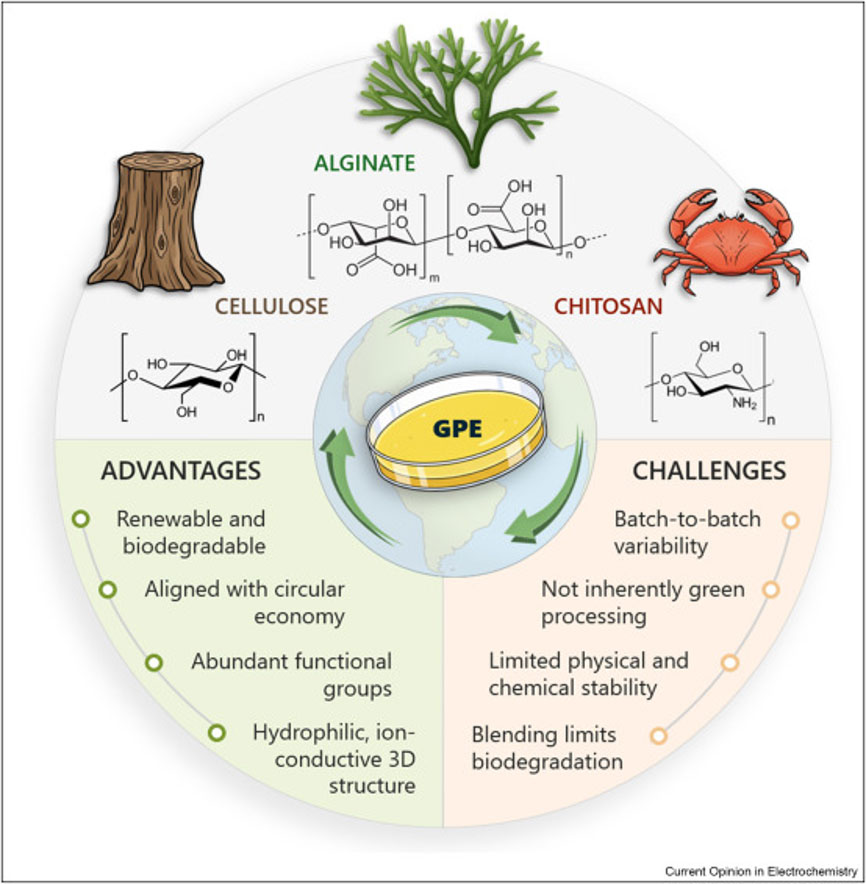
Gel polymer electrolytes (GPEs) have emerged as a potential solution to many of these issues by combining the ionic conductivity of liquid electrolytes with the mechanical stability of solid materials. In particular, biopolymer-based GPEs derived from renewable resources such as cellulose, chitosan, and alginate offer an attractive route toward greener and more sustainable battery technologies.
This review provides a comprehensive overview of recent advances in biopolymer electrolytes for rechargeable zinc-air batteries, discussing their benefits, limitations, and future development pathways.
Main findings
- Biopolymer-based gel polymer electrolytes can improve battery safety by reducing electrolyte leakage, suppressing zinc corrosion, and mitigating dendrite formation.
- Cellulose, chitosan, and alginate are currently the most widely investigated biopolymers for zinc-air battery electrolytes due to their abundance, renewability, and favorable electrochemical properties.
- Many reported biopolymer electrolytes already achieve ionic conductivities and electrochemical performances comparable to those of conventional synthetic polymer electrolytes.
- Significant challenges remain, including chemical degradation under highly alkaline conditions, batch-to-batch variability of natural materials, and the lack of standardized testing methodologies.
- Future progress requires improved alkaline durability, comprehensive sustainability assessments, and the development of standardized protocols to evaluate performance under realistic operating conditions.
Contribution to eNargiZinc
This publication directly supports the objectives of eNargiZinc by exploring sustainable materials for next-generation zinc-based energy-storage technologies. The review highlights how renewable biopolymers can contribute to safer, greener, and more resource-efficient rechargeable zinc-air batteries while identifying the scientific and technological challenges that must be addressed for large-scale implementation. The work also provides valuable guidance for future research on sustainable electrolytes and circular-economy approaches within the energy-storage sector.
Publication details
| Title | Biopolymer electrolytes for rechargeable zinc-air batteries: Advancements and challenges |
|---|---|
| Authors | Barbara Belza, Mattia F. Palermo, Estíbaliz García-Gaitán, Idoia Ruiz de Larramendi, and Nagore Ortiz-Vitoriano |
| Journal | Current Opinion in Electrochemistry |
| Year | 2026 |
| DOI | 10.1016/j.coelec.2026.101821 |
Access the article