Nanocarbon-Assisted Anthraquinone-Conjugated Microporous Polymer Anodes for High-Rate, High-Areal-Output, Wide-Temperature Alkaline Nickel–Organic Batteries
Organic electrodes combine high loading, rapid charging and broad-temperature operation
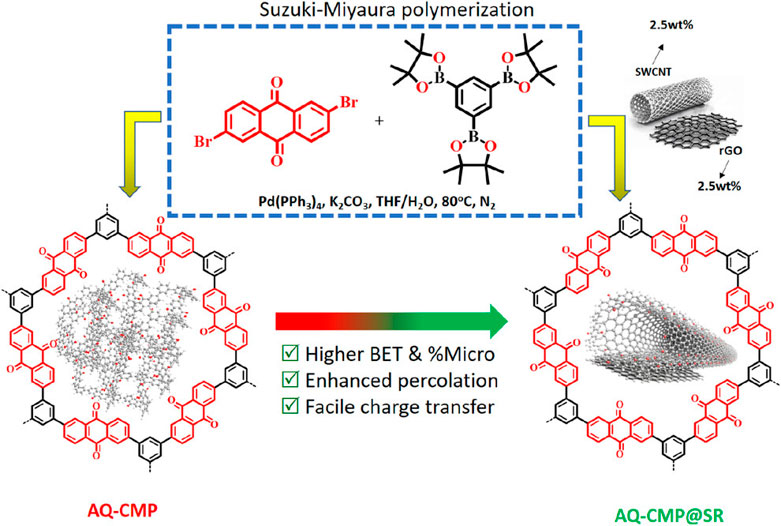
A new open-access study involving researchers from the eNargiZinc project, explores how combining an organic polymer with a conductive nanocarbon network can improve rechargeable aqueous batteries. The resulting anode, Aq-CMP@SR, integrates an anthraquinone-conjugated microporous polymer with single-walled carbon nanotubes and reduced graphene oxide.
Why is this research important?
Organic electrode materials offer considerable freedom to tailor molecular structures and redox properties. For practical battery development, however, energy-storage chemistry must be combined with efficient transport throughout an electrode. A promising material must remain useful when electrodes become thicker and contain more active material per unit area.
In this study, anthraquinone provides the redox-active component, while the nanocarbon network improves electronic transport. The hybrid exhibits lower electrical and charge-transfer resistance than the nonhybrid polymer. The anode was tested with a nickel hydroxide cathode in 1 m KOH.
The broader design challenge is to balance several requirements at once: capacity, electrode composition, mass loading, operating rate and temperature. These metrics help assess whether improvements in a material could translate into more useful electrodes. They should be considered together when comparing battery research.
Main findings
- High active-material content: 143 mAh g⁻¹ on a total-anode-mass basis at 80 wt% polymer content. Reporting the mass basis makes the contribution of conductive additives visible.
- High areal output: 10.1 mAh cm⁻² at 60 mg cm⁻² loading. Areal capacity describes how much charge an electrode stores per unit footprint and complements gravimetric capacity.
- Performance at high current: 4.6 mAh cm⁻² retained at 343 mA cm⁻². This measurement connects charge-storage output with the rate at which the electrode operates.
- Broad temperature range: operation from −45 to +75 °C. Temperature testing helps researchers examine how performance changes across demanding operating conditions.
- Taken together, these results highlight the importance of evaluating electrode performance through several complementary metrics. High capacity alone gives an incomplete picture of the trade-offs involved in practical battery design.
Contribution to eNargiZinc
This publication contributes to eNargiZinc’s broader interest in sustainable energy-storage materials through research on organic electrodes and conductive architectures. From a project perspective, the design approach may offer useful ideas for connecting molecular chemistry, electrode structure and electrochemical performance.
Its relevance also extends to how new materials are assessed: comparisons that account for active-material fraction, mass loading, current and temperature can support more informed development decisions. The demonstrated battery chemistry is nickel–organic. Transferring the approach to sodium- or zinc-based systems would require dedicated investigation.
Publication details
| Title | Nanocarbon-Assisted Anthraquinone-Conjugated Microporous Polymer Anodes for High-Rate, High-Areal-Output, Wide-Temperature Alkaline Nickel–Organic Batteries |
|---|---|
| Authors | Nikhil Medhavi, Hakan Bildirir, Nagaraj Patil, Sergio Pinilla, Marta Liras, Rebeca Marcilla |
| Journal | Small Structures |
| Publication type | Research article (open access, CC BY 4.0) |
| Year | 2026 |
| First published | 17 October 2026 |
| Article number | e70648 |
| DOI | 10.1002/sstr.70648 |