Decoupled redox activity of iron centers upon Zn²⁺ intercalation in Berlin green cathodes
eNargiZinc researchers uncover how distinct iron sites store zinc ions in Berlin green cathodes
We are pleased to announce the publication of a new scientific article resulting from research supported by the eNargiZinc project.
The article, entitled “Decoupled redox activity of iron centers upon Zn²⁺ intercalation in Berlin green cathodes”, was published in Journal of Materials Chemistry A and authored by Hiba Ali, Mariam Maisuradze, Hamideh Darjazi, Marco Giorgetti, Claudio Gerbaldi and Giuseppe Antonio Elia.
Why is this research important?
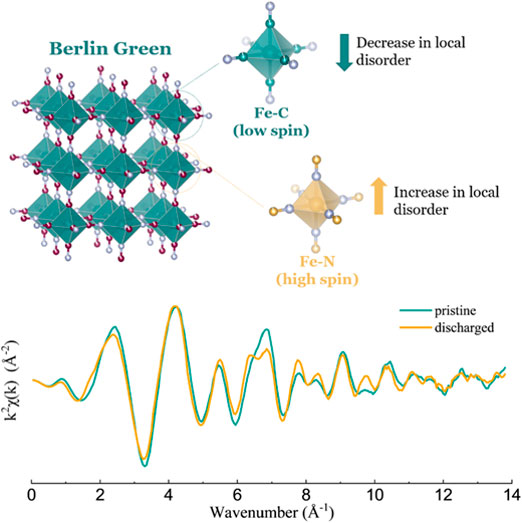
Prussian blue analogues are promising, cost-effective cathode materials for aqueous zinc-ion batteries. However, the mechanisms by which zinc ions are stored at different iron sites remain poorly understood. In Berlin green, iron atoms occupy two distinct coordination environments: low-spin iron bonded to carbon (Fe–C) and high-spin iron bonded to nitrogen (Fe–N).
The researchers synthesized Berlin green and investigated zinc-ion insertion using electrochemical measurements, kinetic analysis and ex situ synchrotron X-ray absorption spectroscopy (XANES and EXAFS). This combined approach enabled them to distinguish the charge-storage behavior and local structural response of the two iron environments.
The results show that the two iron sites respond differently during cycling: Fe–C sites mainly participate in diffusion-controlled zinc intercalation, whereas Fe–N sites show predominantly surface-controlled, capacitive behavior. This site-specific picture helps explain how local coordination chemistry influences zinc-ion storage.
Main findings
- Electrochemical measurements identify two distinct redox couples associated with the carbon-coordinated low-spin Fe sites and nitrogen-coordinated high-spin Fe sites, demonstrating a multistep zinc-storage mechanism.
- Kinetic analysis reveals predominantly diffusion-controlled behavior at Fe–C sites (b-values of close to 0.5) compared with predominantly pseudocapacitive behavior at Fe–N sites (b-values close to 1).
- Berlin green delivers an initial discharge capacity of approximately 90 mAh g-1 at 20 mA g-1 and retains approximately 75 mAh g-1 after 20 cycles (83.3% capacity retention).
- Synchrotron X-ray absorption analysis shows relatively limited changes in the average electronic structure after the 10th discharge, while EXAFS reveals decreased local disorder at Fe–C sites and increased disorder at Fe–N sites after cycling.
- The Fe–C–N–Fe framework remains largely intact after zinc insertion, supporting a direct connection between local coordination environments, ion-transport limitations and electrochemical response.
Contribution to eNargiZinc
This publication contributes to eNargiZinc by advancing the fundamental understanding of zinc-ion storage in sustainable, iron-based cathode materials. By identifying distinct electrochemical and structural responses at individual iron sites, the work provides mechanistic guidance for designing and optimizing Prussian blue analogue cathodes for more durable, affordable aqueous zinc-based energy-storage systems.
Publication details
| Title | Decoupled redox activity of iron centers upon Zn2+ intercalation in Berlin green cathodes |
|---|---|
| Authors | Hiba Ali, Mariam Maisuradze, Hamideh Darjazi, Marco Giorgetti, Claudio Gerbaldi and Giuseppe Antonio Elia |
| Journal | Journal of Materials Chemistry A |
| Publication type | Review (open access) |
| Year | 2026 |
| DOI | 10.1039/d6ta05185e |