
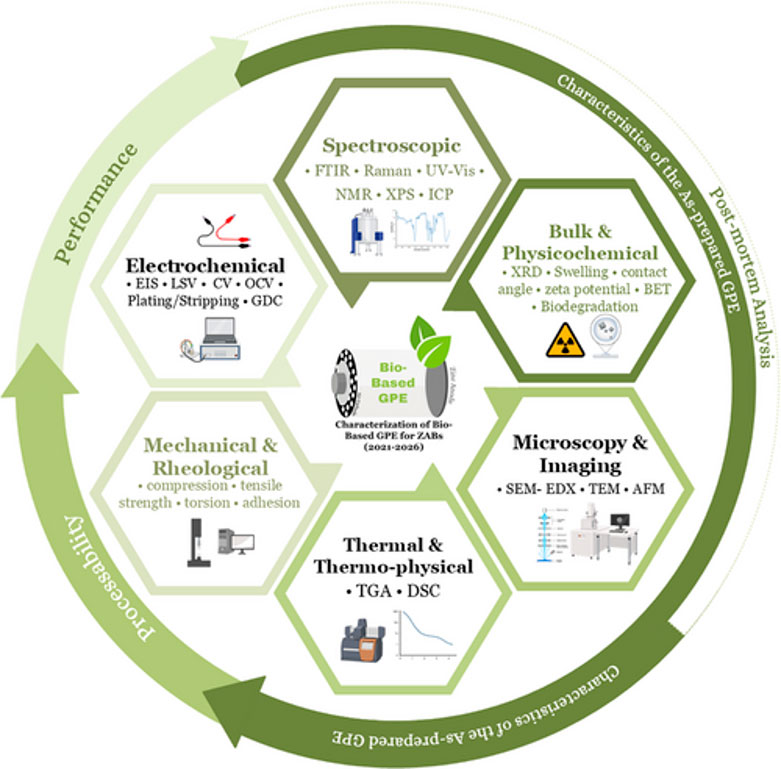
New review: Characterizing Biopolymer Electrolytes in Zinc–Air Batteries: Challenges, Best Practices, and a Robust Workflow Guiding Future Research Paths
eNargiZinc researchers outline best practices for evaluating sustainable biopolymer electrolytes in zinc–air batteries.
We are pleased to announce a new open-access review article involving researchers from the eNargiZinc project.
This publication acknowledges funding from both the eNargiZinc project and the HIPERZAB project.
The review, entitled “Characterizing Biopolymer Electrolytes in Zinc–Air Batteries: Challenges, Best Practices, and a Robust Workflow Guiding Future Research Paths”, was published in Advanced Energy Materials on 21 September 2026. It was authored by Matteo Milanesi, Hiba Ali, Barbara Belza, Mattia F. Palermo, Claudio Gerbaldi, Giuseppe Antonio Elia, and Nagore Ortiz-Vitoriano. Matteo Milanesi and Hiba Ali contributed equally to this work.
Why is this research important?
Rechargeable zinc–air batteries are attractive candidates for more sustainable energy storage because zinc is relatively abundant and affordable. However, improving their durability and practical performance requires electrolytes that remain effective under demanding operating conditions, including strongly alkaline environments and continuously evolving electrode interfaces.
Bio-based gel polymer electrolytes can combine ion transport with mechanical flexibility and reduced reliance on conventional synthetic materials. Yet, comparing formulations across studies is difficult when characterization protocols, testing conditions and reported parameters differ. This review critically examines recent research published between 2021 and 2026 and identifies how to assess these materials more reliably.
Rather than simply listing experimental techniques, the authors explain which properties each method can reveal, the limitations of the measurements, and how characterization should be connected to realistic zinc–air battery operation.
Main findings and recommendations
- The review organizes characterization methods into six complementary categories: mechanical and rheological tests; electrochemical and cell-level tests; spectroscopy; microscopy and nanoscale imaging; thermal analysis; and bulk physicochemical measurements.
- The review stresses on the necessity to interpret experimental results in the context of strong alkaline conditions, dynamic electrode interfaces and the soft, heterogeneous structure of biopolymer networks.
- The review addresses the limitations in the field of biopolymers, specifically the inconsistencies in experimental protocols and reporting, that can hinder meaningful comparisons between electrolyte formulations and obscure their practical performance.
- No single technique is sufficient: combining structural, mechanical, physicochemical and electrochemical measurements provides a more complete understanding of electrolyte behavior.
- The authors propose a workflow-oriented approach linking electrolyte formulation, material structure, interfacial behavior and full-cell performance, alongside practical best-practice recommendations and emerging characterization strategies.
Contribution to eNargiZinc
This review supports eNargiZinc’s objective of developing more sustainable and affordable zinc-based energy-storage technologies. By identifying reliable ways to characterize bio-based gel polymer electrolytes, it provides methodological guidance for designing, comparing and optimizing materials intended for rechargeable zinc–air batteries.
The proposed framework can help researchers evaluate electrolyte properties under application-relevant conditions, understand how material structure and interfaces affect performance, critically assess which technique the scope and limitation of each technique and improve reproducibility across studies. It therefore contributes to more informed materials selection and to the development of robust, sustainable battery components.
Publication details
| Title | Characterizing Biopolymer Electrolytes in Zinc–Air Batteries: Challenges, Best Practices, and a Robust Workflow Guiding Future Research Paths |
|---|---|
| Authors | Matteo Milanesi, Hiba Ali, Barbara Belza, Mattia F. Palermo, Claudio Gerbaldi, Giuseppe Antonio Elia, Nagore Ortiz-Vitoriano |
| Journal | Advanced Energy Materials |
| Publication type | Review (open access) |
| Year | 2026 |
| First published | 21 September 2026 |
| Article number | e71394 |
| DOI | 10.1002/aenm.71394 |
