New publication: Real-time gas evolution analysis of SEI formation in sodium-ion batteries using chip based electrochemistry mass spectrometry
eNargiZinc researchers reveal how electrolyte chemistry controls gas evolution and SEI formation in sodium-ion batteries
We are pleased to announce the publication of a new scientific article resulting from research supported by the eNargiZinc project.
The article, entitled «Real-time gas evolution analysis of SEI formation in sodium-ion batteries using chip based electrochemistry mass spectrometry», has been published in Faraday Discussions and was authored by Shivam Sharma, Bethan J. V. Davies, Mary P. Ryan, Ifan E. L. Stephens, and Maria Magdalena Titirici.
Why is this research important?
The solid electrolyte interphase (SEI) is critical to the long-term performance of sodium-ion batteries, particularly when hard carbon is used as the anode. Its formation depends strongly on electrolyte decomposition, yet the direct relationship between solvent chemistry, gas evolution, and SEI development remains insufficiently understood.
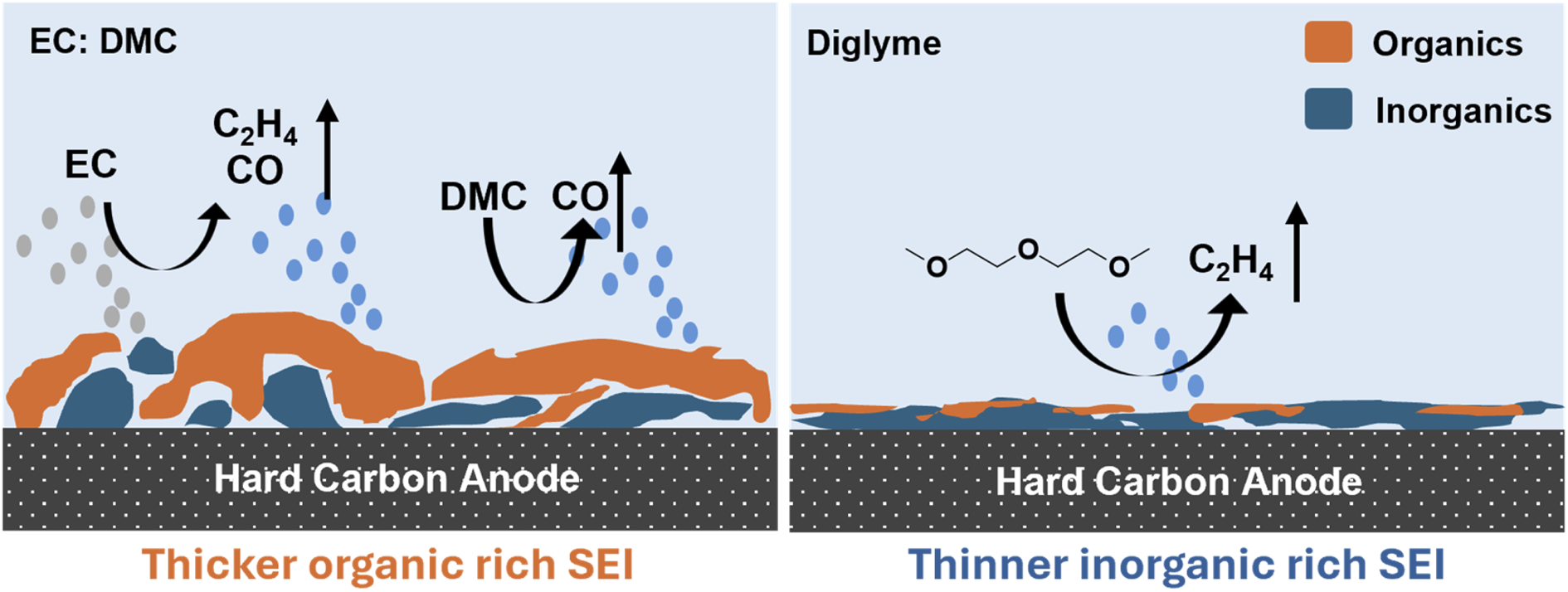
This work applies operando chip-based electrochemistry-mass spectrometry (EC-MS), with picomole-per-second sensitivity, to monitor gas evolution in real time during SEI formation on hard-carbon anodes. The study compares carbonate-based EC:DMC and ether-based diglyme electrolytes under equivalent electrochemical conditions.
By directly tracking gaseous decomposition products, the study connects solvent-dependent electrolyte degradation with the nature and stability of the resulting SEI and demonstrates the value of EC-MS for resolving interfacial reaction pathways in sodium-ion batteries.
Main findings
- Carbonate-based EC:DMC electrolyte shows pronounced gas evolution during the first discharge, dominated by ethylene (C2H4), consistent with reductive decomposition of ethylene carbonate and formation of sodium ethylene dicarbonate and Na2CO3-rich interphase species.
- Diglyme strongly suppresses gas evolution, with only small quantities of C2H4 detected, indicating a lower degree of solvent decomposition and the formation of a thinner, more stable SEI.
- Diglyme-based cells also show superior rate capability and cycling stability: at 2 C they retain around 270 mAh g-1, compared with approximately 50 mAh g-1 for EC:DMC, and they maintain higher capacity over 100 cycles at 0.5 C.
- Gas evolution in both electrolyte systems occurs predominantly during the first discharge, showing that the principal gas-forming reactions associated with SEI formation take place in this initial reductive window.
- Operando chip-based EC-MS provides direct, time-resolved evidence linking solvent chemistry, electrolyte decomposition, gas evolution, and SEI formation, offering a mechanistic framework that can be complemented by advanced characterization techniques.
Contribution to eNargiZinc
This publication contributes to eNargiZinc by advancing the understanding of interfacial degradation processes in sodium-ion batteries. By clarifying how electrolyte solvent chemistry influences gas evolution, SEI formation, rate capability, and cycling stability on hard-carbon anodes, the work supports the development of more stable and durable sodium-based energy-storage systems. It also demonstrates an operando analytical approach that can help identify electrolyte degradation pathways and guide future electrolyte and interface optimization.
Publication details
| Title | Real-time gas evolution analysis of SEI formation in sodium-ion batteries using chip based electrochemistry mass spectrometry |
|---|---|
| Authors | Shivam Sharma, Bethan J. V. Davies, Mary P. Ryan, Ifan E. L. Stephens, and Maria Magdalena Titirici |
| Journal | Faraday Discussions |
| Year | 2026 |
| DOI | 10.1039/d6fd00028b |
Access the article