
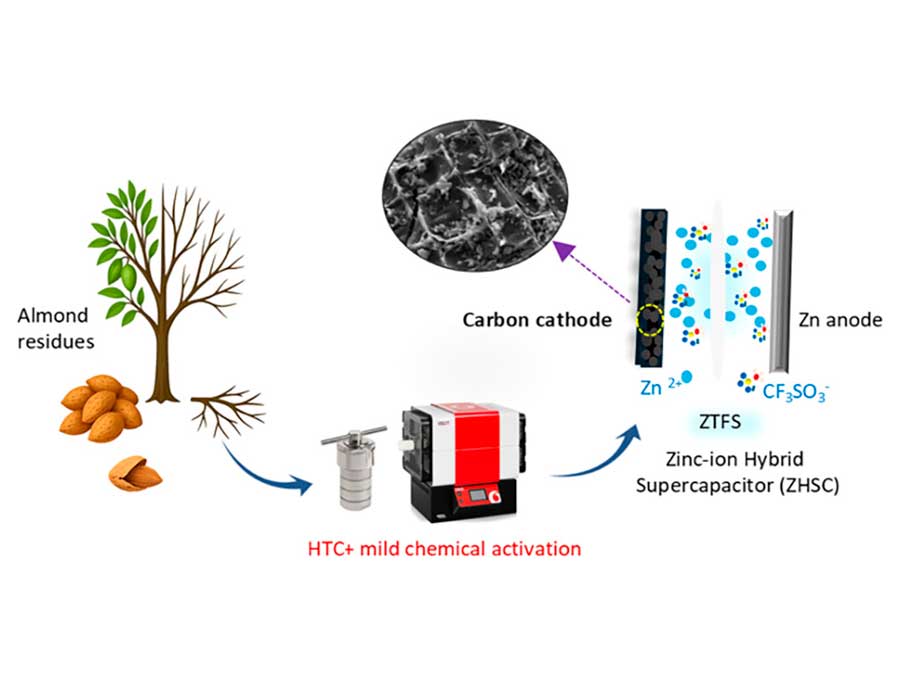
Hierarchically Porous Carbons from Almond Residues via Hydrothermal Pretreatment and Mild K2CO3 Activation for Aqueous Zinc Hybrid Supercapacitors
eNargiZinc researchers publish new findings on sustainable biomass-derived carbon electrodes for zinc-based energy storage.
We are pleased to announce the publication of a new scientific article resulting from research carried out within the eNargiZinc project.
The study, entitled «Hierarchically Porous Carbons from Almond Residues via Hydrothermal Pretreatment and Mild K₂CO₃ Activation for Aqueous Zinc Hybrid Supercapacitors», has been published in Energy & Fuels and was authored by Densa A. Shaj, Darío Alvira, Daniel Antorán, Víctor Sebastián, and Joan J. Manyà.
Why is this research important?
The development of sustainable and affordable electrochemical energy-storage systems requires electrode materials that combine high performance with low environmental impact. Biomass-derived carbons are promising candidates, but many preparation methods rely on corrosive activating agents and result in low carbon yields.
In this work, almond-tree pruning residues and almond shells, both abundant agricultural by-products, were converted into high-performance porous carbon electrodes through a greener process combining hydrothermal pretreatment and mild K₂CO₃ activation. The resulting materials were evaluated as cathodes for aqueous zinc-ion hybrid supercapacitors, demonstrating excellent electrochemical performance while promoting the valorization of local agricultural waste streams.
Main findings
- Hydrothermal pretreatment significantly enhanced pore development, surface area, and mesoporosity while maintaining high carbon yields.
- Carbons derived from almond-tree pruning residues outperformed those obtained from almond shells, highlighting the importance of precursor structure on electrode properties.
- The best-performing electrode delivered a specific capacity of 142 mAh g⁻¹ at 0.1 A g⁻¹.
- Excellent cycling stability was achieved, with 91% capacity retention after 10,000 cycles at 10 A g⁻¹.
- The assembled zinc-ion hybrid supercapacitor reached an energy density of 87.8 Wh kg⁻¹ while maintaining good power performance, demonstrating the potential of sustainable biomass-derived carbons for next-generation zinc-based energy-storage systems.
Contribution to eNargiZinc
This publication directly supports the objectives of eNargiZinc by advancing the development of sustainable electrode materials derived from locally sourced biomass residues. The work demonstrates a circular-economy approach in which agricultural waste is transformed into high-value carbon materials for aqueous zinc-based energy-storage devices. The results contribute to the project’s efforts to develop affordable, environmentally friendly, and resource-efficient alternatives for future electrochemical energy-storage technologies.
Publication details
| Title | Hierarchically Porous Carbons from Almond Residues via Hydrothermal Pretreatment and Mild K₂CO₃ Activation for Aqueous Zinc Hybrid Supercapacitors |
|---|---|
| Authors | Densa A. Shaj, Darío Alvira, Daniel Antorán, Víctor Sebastián, Joan J. Manyà |
| Journal | Energy & Fuels |
| Year | 2026 |
| DOI | https://doi.org/10.1021/acs.energyfuels.6c00654 |
Access the article
