Unravelling sodium-ion transport, kinetic properties and ageing mechanisms in Mn-rich Na₃.₄Mn₁.₂Ti₀.₈(PO₄)₃/C NASICON cathode
New eNargiZinc publication sheds light on sodium-ion transport and degradation mechanisms in NASICON cathodes.
We are pleased to announce the publication of a new scientific article contributing to the advancement of sustainable sodium-ion battery technologies.
The article, entitled «Unravelling sodium-ion transport, kinetic properties and ageing mechanisms in Mn-rich Na₃.₄Mn₁.₂Ti₀.₈(PO₄)₃/C NASICON cathode», has been published in Electrochimica Acta and investigates the electrochemical behaviour of a manganese-rich NASICON cathode material for sodium-ion batteries.
Why is this research important?
Sodium-ion batteries are attracting increasing interest as a sustainable and cost-effective alternative to lithium-ion technologies, particularly for large-scale energy storage applications. Among the various cathode materials under development, NASICON-type phosphates stand out due to their excellent structural stability, safety, and fast sodium-ion transport properties.
However, manganese-rich NASICON cathodes still face several challenges, including voltage hysteresis, incomplete utilization of active redox centres, and gradual capacity loss during long-term cycling. Understanding the origin of these limitations is essential for developing higher-performance sodium-ion batteries.
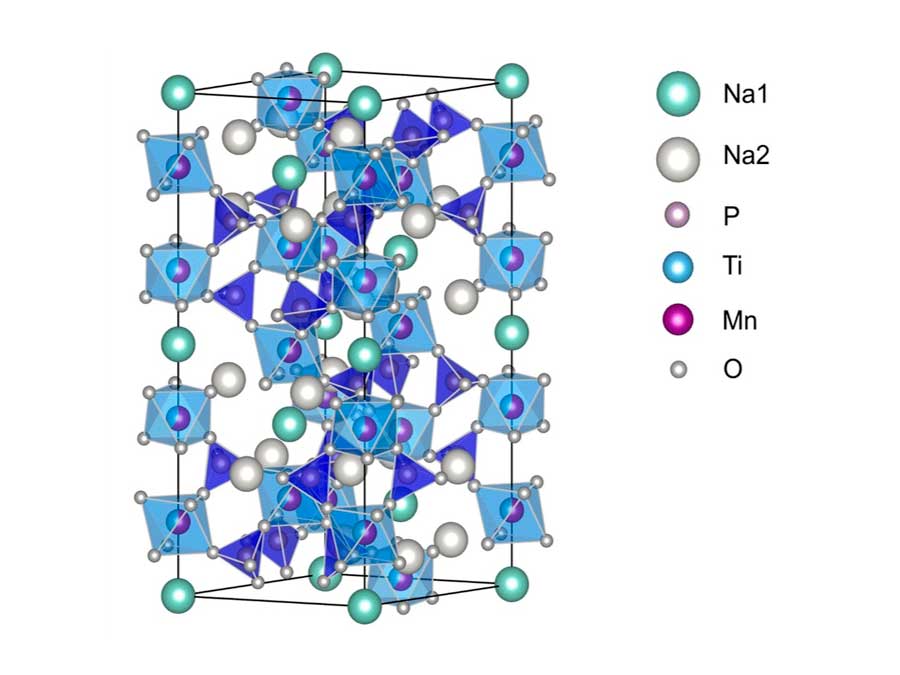
This study provides a comprehensive electrochemical investigation of the Mn-rich NASICON compound Na₃.₄Mn₁.₂Ti₀.₈(PO₄)₃/C, combining advanced characterization techniques to reveal how sodium-ion transport, reaction kinetics, and structural features influence battery performance and ageing.
Main findings
- The material exhibits a stable NASICON crystal structure with excellent long-term structural integrity and efficient sodium-ion transport pathways.
- High-rate performance is mainly limited by kinetic polarization, which shifts electrochemical reactions outside the operating voltage window and reduces accessible capacity at high current densities.
- Voltage hysteresis and incomplete sodium extraction cannot be explained solely by kinetic effects. The study identifies intrinsic structural disorder, caused by manganese ions occupying sodium vacancies, as a major contributing factor.
- Advanced electrochemical analyses demonstrate that sodium diffusion remains relatively fast throughout most of the charge-discharge process, highlighting the intrinsic advantages of the NASICON framework.
- Long-term ageing studies reveal that capacity fade is primarily associated with a gradual slowdown of sodium-ion diffusion within the material rather than interfacial degradation or structural collapse. Even after 1500 cycles, no significant structural deterioration was observed.
Contribution to eNargiZinc
The development of sustainable sodium-based energy-storage technologies is one of the central objectives of the eNargiZinc project. This work provides valuable insights into the fundamental mechanisms governing sodium-ion transport and degradation in NASICON cathodes, helping researchers identify the key factors limiting performance and lifetime.
By clarifying the origins of voltage hysteresis, capacity loss, and ageing, the study contributes to the design of more durable and efficient sodium-ion batteries based on abundant and environmentally friendly materials, supporting the transition towards sustainable energy-storage solutions.
Publication details
| Title | Unravelling sodium-ion transport, kinetic properties and ageing mechanisms in Mn-rich Na₃.₄Mn₁.₂Ti₀.₈(PO₄)₃/C NASICON cathode |
|---|---|
| Authors | Luca Bottoni, M. Arslan, L. Minnetti, F. Lischio, S. Pacetti, M. Piechocki, and F. Nobili |
| Journal | Electrochimica Acta |
| Year | 2026 |
| DOI | 10.1016/j.electacta.2026.149011 |
Access the article